
The Capability Era
Most business owners do not have an information problem.
They know more than they have ever known before. They have access to strategies, frameworks, tools, and advice at a level that would have been unimaginable even a decade ago.
And yet, many still feel stuck or cautious about their next move.
It’s not because they are missing something, it’s because knowing what to do is no longer the thing that determines whether anything actually happens.
The world that shaped how we approached business growth was one where information was scarce. If you wanted to learn how to build a marketing strategy, lead a team, or navigate change, you had to find someone who knew how to do that or develop that knowledge and skills yourself. You attended the workshop. You hired the consultant. You bought the book and followed the process.
The value sat in the knowing, because knowing was hard to access.
That world no longer exists in the same way.
Somewhere between the rise of search engines and the acceleration of artificial intelligence, access to knowledge stopped being the constraint. Any question a business owner could bring to a workshop, a mentor, a masterclass, or a consultant can now be answered in thirty seconds. The frameworks exist. The strategies have been documented. The blueprints have been written, rewritten, repackaged, and redistributed across every platform, at every price point, in every format imaginable.
And yet something is not working.
Not all businesses are growing faster. Leaders are not making consistently better decisions. If anything, the gap between knowing what to do and actually doing it has become more visible. In many cases, it has widened because the volume of available information has created a new problem: the paralysis of endless learning as a substitute for action.
We are not in the Information Age anymore.
We are in the Capability Era.
What Changed
Information is no longer the advantage. Knowledge is no longer a competitive advantage.
Frameworks, strategies, and playbooks are everywhere. You can learn almost anything from every type of ‘expert’, often for free, and often instantly.
But this access to a multitude of expertise has not translated into action.
Jeffrey Pfeffer & Robert I. Sutton call it The ‘Knowing-Doing’ Gap to explain why organisations fail to turn knowledge into action.
A pattern I see regularly is a continuous loop, business owners searching for the answers to their problems externally from ‘experts’ and when it doesn’t work, moving on to the next promise, blueprint or checklist in the hope that that will work instead.
When we buy other people’s knowledge, we miss the opportunity to develop our own decision-making capabilities.
Global research continues to reinforce this shift. The World Economic Forum highlights that the most in-demand capabilities for the future are not knowledge-based, but human capabilities such as critical thinking, problem solving, adaptability, and self-management.
Many business owners know what they should be doing. They have read it, heard it, or even written it down themselves. The challenge is not awareness. The challenge is execution.
Knowing more has never been the bottleneck. It has felt like the bottleneck, because information was the most visible gap and filling it was the most straightforward thing to offer. But the actual constraint, the thing that has always determined whether a business grows, whether a strategy executes, whether a leader develops has always been human.
Not human in the vague, feel-good sense. Human in the specific, uncomfortable, consequential sense. The leader's capacity to apply what they know under real conditions. Their ability to tolerate the discomfort of trying before they are ready. Their willingness to be honest about where they actually are rather than where they wish they were. Their self-awareness about the patterns that keep producing the same results. Their confidence to commit to one direction when several seem plausible.
Rather than soft skills, these are the highest-order business capabilities that exist, and they cannot be built through information alone.
A Reflection From the Work
When we started 25eight, we believed the biggest problem we were solving was time.
We saw business owners who were stretched, overwhelmed, and constantly putting their own strategic development in the “when I get a moment” category. So we focused on making skill acquisition faster, more accessible, more efficient. We designed it specifically to fit into already full lives.
And that matters too. Business owners are time and resource-poor with many being ‘chief everything officer’.
But over time, we noticed something else.
The leaders who made the most progress were not the ones with the most time. They were the ones with the strongest internal driver to change. They made time.
(Consequently, this sparked a whole new branch of our research and a weekly podcast - Make Time, listen here).
Not because their calendar cleared, but because something shifted in how they saw themselves, their business, and what was possible.
This aligns with decades of research from Edward Deci and Richard Ryan on intrinsic motivation. When people are internally driven by purpose, autonomy, and mastery, they do not wait for time to appear. They reorganise their behaviour around what matters.
Time was not the real constraint. Human capability was.
More specifically, the capability to translate intention into action. To take what they knew and actually do something with it. To keep going when it felt uncomfortable or uncertain and that changed how we saw the problem entirely.
The Tools We Are Still Reaching For
One of the most frustrating aspects of our work is that workshops or sessions with ‘experts’ are considered the perfect solution to address any perceived lack in a business or business community. Despite what feels like a clear (potential ranting) explanation of how a workshop will not achieve the outcomes they aspire to, a workshop is the solution they desire.
This is not an argument against workshops, mentoring, or expert guidance, these things have genuine value. They build awareness. They spark curiosity. They introduce people to ideas they would not have found on their own. At the right moment in someone's development, a single conversation with the right person or a single day in the right room can be genuinely life-changing.
The problem is not the tools. The problem is what we believe the tools can do.
A workshop can move someone from unaware to aware. That is valuable, but it is also its limit.
It cannot build capability on its own, awareness or understanding doesn’t create outcomes regardless of how ‘interactive’ the session is. It won’t changed behaviour.
Capability is not produced by exposure to information. It is produced by guided application, honest feedback, iteration under real conditions, and sustained practice over time. It is built through the discomfort of trying something before you have mastered it, failing in ways that teach you something specific, adjusting, and trying again. It requires a structured, supported environment in which that application can happen with appropriate guidance and genuine accountability.
Research from McKinsey & Company consistently shows that capability building requires more than knowledge transfer. It requires practice, feedback, and real-world application embedded over time. I want to emphasise the last part of that again because this is really important. Despite our insatiable need for things to happen instantaneously, capabilities can only be built over time through a sequence of events.
Capability comes from applying knowledge in a real context. It comes from trying, adjusting, getting feedback, and trying again. It comes from working through the tension between theory and reality.
Without that, learning stays theoretical. It stays as awareness or understanding. In fact, if it is not applied immediately, that awareness and understanding can often be lost.
When we keep reaching for those tools after the information problem has already been solved, we are not helping ourselves grow. We may feel like we are growing, it feels like progress. We may attend another workshop, purchase another course, use another ‘expert’ framework or perspective, but nothing changes.
This isn’t because we are doing something wrong, it's because the structure of delivery was designed for a different problem.
If we deliver workshops to build capabilities we are offering the comfort of learning as a substitute for the discomfort of doing.
What the Capability Era Demands
If the Information Age rewarded knowing, the Capability Era rewards doing.
More specifically, it rewards the ability to apply what you know in your own context and refine it over time.
That shift has implications for every aspect of how we approach business development, leadership growth, and the support structures we build around both.
For example, it changes where you start because instead of beginning with content, you begin with diagnosis. It means that the most important question is no longer "what do you know?" It is "what can you actually do with what you know, in your specific situation, right now?"
The diagnostic replaces the curriculum as the starting point. You cannot build the right capability without an honest picture of where the gaps actually are. And this is often not where the person suspects they might be..
It changes how you learn, because building capability requires meaningfully applying and refining your knowledge and this means your new knowledge has to be applied to something real. A real customer. A real strategy. A real decision.
The business owner who works through a marketing framework applied to their actual customers, in their actual market, producing actual content or an actual strategy, develops a capability that the person who learns the same framework in the abstract does not.
The artefact, which is the output produced through the application of learning, is the evidence of capability. The evidence that knowledge has been applied appropriately.
That’s why we don’t do quizzes or tests in our education at 25eight. We don’t measure your retention of the knowledge, we assess your application of it through evidence of an output or artefact in your business. We also consider that you could master a capability through demonstration of your refinement of that output of artefact based on new knowledge.
It means that the human variable cannot be bypassed:
Leaders who lack strategic clarity will use AI to produce faster confusion.
Leaders who lack self-awareness will use coaching to confirm what they already believe.
Leaders who cannot tolerate the discomfort of application will collect frameworks indefinitely.
The development of the human, their confidence, their self-awareness, their capacity to act under uncertainty, is not a prerequisite for the ‘real work’. It is the real work. Everything else is happens because of that.
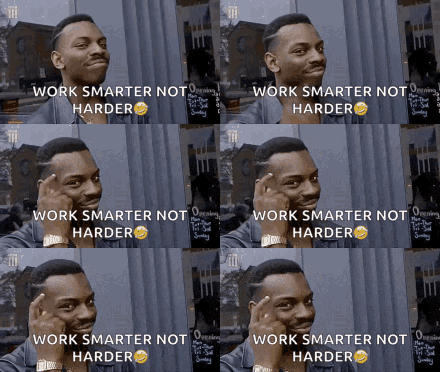
And this doesn’t necessarily mean working harder. It means working smarter.
And it means that measurement has to change. Attendance figures and satisfaction scores measure the Information Age. They tell you whether people showed up and whether they felt good about what they heard.
They tell you nothing about whether capability changed.
The Capability Era demands a different evidentiary standard: pre and post diagnostic shift, artefact quality, behavioural change, outcomes produced. Not whether someone learned something. Whether someone can now do something they could not do before.
And as a leader, that’s what you should demand of anything taking your attention.
Why AI Makes This Impossible to Ignore
Artificial intelligence did not create the Capability Era, but it has made it impossible to ignore.
When information is free and instantaneous, when any question can be answered, any framework retrieved, any expert's system accessed within seconds, the only remaining differentiator is the capacity to use that information well. To ask the right questions. To apply the answers to a specific context with sound judgment. To know which framework fits this situation and which does not. To lead a team through change rather than simply understanding the theory of change management.
These capacities are not produced by AI. They are amplified by it. AI makes capable people more capable and reveals, more quickly than anything that has come before, the gap between those who have done the real work of building genuine capability and those who have been collecting the appearance of it.
Recent insights from Harvard Business Review and McKinsey & Company show that AI does not deliver value on its own. The impact depends heavily on the capability of the person using it, particularly their judgment, context awareness, and decision-making ability:
The ability to ask better questions.
To interpret what comes back.
To apply it in a specific context.
To make decisions with incomplete information.
AI amplifies capability; it doesn't replace it. (See why in this video)
And in doing so, it exposes the gap; the gap between people who have built real capability through application and those who have accumulated knowledge without ever fully using it.
For business owners, this is where the real opportunity sits and a specific urgency that no amount of AI tool training addresses.
The question is not which tools to use. The question is whether the leader using the tools has the human capabilities required to use them well. Strategic clarity. Sound judgment. The ability to distinguish signal from noise. The confidence to act on incomplete information. The self-awareness to know when they are the constraint.
These cannot be downloaded. They cannot be installed. They are built through real work, over time, with honest support and genuine accountability to become the kind of leader your business needs in the AI Economy.
An Invitation
I have spent over a decade working with small and medium business owners at exactly the moment when the gap between knowing and doing becomes impossible to ignore.
There is a sense of being stuck in where you are, a hamster wheel effect, a caution about the next move, or a system/tool has been implemented and nothing has changed.
A workshop or expert solution seems a quick and easy fix, it’s just 1-3 hours of your time.
But the problem is rarely solved with the content delivered in a workshop.
The problem is almost always a capability one that needs a different approach. One focused on the human, the individual, as well as the business.
The Capability Era does not need more content. It does not need better blueprints or smarter frameworks or more accessible masterclasses. It needs more people who are willing to do the real work on themselves, on the gap between what they know and what they can actually do, on the honest and deeply unglamorous process of building genuine capability in real conditions.
That work is harder than attending a workshop. It is slower than following a blueprint. It requires honesty about where you actually are, commitment to sustained application rather than continued consumption, and the willingness to be supported rather than simply informed.
It is also the only work that actually compounds. The leader who builds genuine capability does not need to keep returning to the source. They carry it with them. They apply it in contexts the program designer never imagined. They develop others around them. They build businesses that are not dependent on their founder's knowledge but on their organisation's embedded capability.
That is what the Capability Era makes possible, for the people willing to do what it asks.
If you have been reading this and recognising something you have known for a while but have not had clear language for; the exhaustion with solutions that solve the wrong problem, the sense that what you need is not more information but a different kind of support; then you already understand what this is about.
We’ve been quietly serving leaders who want to become their own business gurus, those who value something more honest, fulfilling and longer-lasting. Those ready to do the real work.
If you know that you’re capable of more, know that you’re right. We can help you. The real work is here, when you are ready for it.
Samantha Hurley is the CEO of 25eight. She has spent a decade helping small and medium business leaders build capabilities in changing economies resulting in with significant measured increases in a short space of time.
Listen to the episode of Make Time: Knowledge vs Capability:
Be first to map your capabilities in the public access Small Business Capability Gap tool launching next month. Sign up to our newsletter to get it direct to your inbox.